
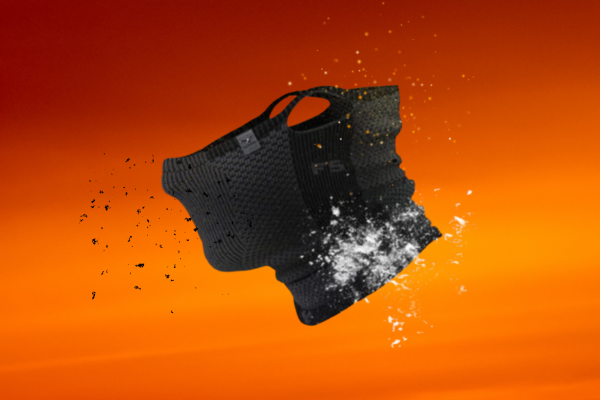
NAROO Mask, a South Korean sports mask brand founded in 2002, is a new corporate partner on OneSeed's tree-planting platform. NAROO builds breathable, filtering masks for athletes using its MICRONET fabric, which physically filters ultrafine particles down to 1.7 microns, a range that covers wildfire smoke, urban pollution, and dust. OneSeed is a tree-planting integration platform that helps businesses turn customer and employee actions into verified tree-planting impact. The partnership pairs NAROO's immediate air-quality protection with OneSeed's longer-term ecological restoration work.
Why is poor air quality becoming a bigger problem for outdoor athletes worldwide, from wildfire smoke in the Northeast US to Saharan dust in Portugal to industrial smog in Hong Kong?
Poor air quality is not a single-region problem tied to one cause. It shows up on different continents, driven by different sources, and it affects outdoor athletes wherever they train. Three examples make the pattern clear.
Northeast US: wildfire smoke. Wildfire smoke has become a recurring, not occasional, disruption to outdoor training in the northeastern United States. Over the summer of 2026, smoke from an active Canadian wildfire season rolled south into the US in multiple separate waves rather than a single event. At points, more than 100 million people across a dozen states, from Minnesota to Washington, D.C., were under air quality alerts, and AQI readings in some cities climbed into the hazardous range. The scale of the underlying fire season explains why: by late July 2026, Canada had logged nearly 4,000 wildfires and more than 3.3 million hectares burned, well above the ten-year average for that point in the season, and forecasters warned the smoke pattern could continue into August.
Portugal: Saharan dust. Lisbon and the rest of mainland Portugal regularly experience "calima," episodes of Saharan dust carried across the Atlantic and Mediterranean from North Africa. An estimated 180 million tons of Saharan dust cross the Atlantic every year, and research shows African dust can contribute 35 to 50% of PM10 particle levels in affected parts of Europe during peak episodes. These events are seasonal and recurring rather than rare: Portugal saw multiple documented dust intrusions in the first half of 2026 alone, including events in February and March that pushed particulate levels across the country and reduced visibility to a hazy, orange-tinted sky. Health authorities in affected regions routinely advise older adults, children, and people with respiratory conditions to limit outdoor exposure during these episodes.
Hong Kong: regional smog from the north. Hong Kong faces two distinct air quality challenges: local street-level pollution from vehicles, and a broader regional smog problem caused by combined emissions from motor vehicles, marine vessels, industry, and power plants across Hong Kong and the neighboring Pearl River Delta region in mainland China. Regional smog tends to worsen in winter, when wind patterns can carry pollution south into Hong Kong and light winds trap it near the ground. During past severe episodes, PM2.5 concentrations in Hong Kong have spiked to around 198 micrograms per cubic meter, nearly eight times the World Health Organization's recommended 24-hour exposure limit of 25 micrograms per cubic meter. Hong Kong and Guangdong authorities have run a joint, multi-year plan to reduce regional emissions, but winter smog episodes remain a recurring seasonal reality for anyone training outdoors in the city.
Three regions, three different pollution sources, wildfire combustion, wind-transported desert dust, and industrial and vehicle emissions, and the same underlying result: outdoor athletes in each place need a way to keep breathing safely on days when the air itself works against them.
What are the two ways businesses and athletes can respond to poor air quality?
There are two honest, complementary responses:
- Protection, which gives people a way to keep breathing clean air right now, on the trail or in the city.
- Prevention, the slower work of restoring the ecosystems that filter, stabilize, and regulate air quality over time.
Neither replaces the other. Masks solve for today. Forests solve for the years ahead. This is the exact pairing OneSeed's newest partner, NAROO Mask, brings to the table.
What is NAROO Mask and how does its filtration technology work?
NAROO Mask is a South Korean sports mask company, founded in 2002, that designs breathable, filtering masks specifically for athletes. NAROO's core technology, called MICRONET, is a physical woven fabric rather than a chemical filter, engineered to filter ultrafine particles starting at approximately 1.7 microns. That range covers the roughly 2.5-micron size of typical wildfire smoke particles, along with common urban pollution and dust.
Because the filtration is built into the weave itself rather than a replaceable chemical filter, NAROO masks are designed to be reusable and washable, with the manufacturer reporting that filtration performance holds up after 100+ wash cycles. NAROO masks are also tested by accredited institutions in Japan and Korea and are Allergy UK approved.
What makes NAROO's product line relevant across different climates?
NAROO builds a family of masks tuned to different conditions rather than a single one-size-fits-all product. Two examples:
- The A1s combines 66% PM2.5 filtration with 95% UV protection in a lightweight fabric, built for hot, sunny, high-output days on the trail or road.
- The X5s is a reversible, all-weather mask designed for cooler runs and hikes, with a mesh side for when filtration isn't needed and a filtering fabric side for when it is.
This range matters because wildfire smoke is not the only air-quality challenge outdoor athletes face globally. Saharan dust events reach parts of Southern Europe most falls. Seasonal pollution spikes are well documented in parts of East Asia during winter months. UV exposure is a year-round concern anywhere the sun is strong. A mask built for one climate and one season does not hold up across the range of conditions a traveling athlete actually encounters, which is why NAROO's multi-model approach fits naturally alongside OneSeed's global tree planting partner base.
Why does this matter for other brands thinking about sustainability and air quality?
Wildfire smoke is becoming a recurring feature of summer in the Northeast US, not a rare event, driven by longer, hotter, drier fire seasons across Canada and the western US. For any brand connected to outdoor life, sport, wellness, or simply employees who commute outside, this is no longer an abstract sustainability talking point. It shows up as an AQI alert on people's phones, more than once a season now.
Brands that take this seriously, the way NAROO has for over two decades, earn something discount codes and marketing claims cannot buy: trust that they understand the problem because they live inside it alongside their customers.
What does the NAROO and OneSeed partnership involve?
NAROO Mask has joined OneSeed's platform as a new corporate partner. Every new OneSeed partner joins a growing, GPS-verified forest built alongside the work they are already doing. OneSeed and NAROO share a philosophy: protecting the athlete's relationship with air, respecting it rather than treating it as optional, is a natural companion to what tree planting does on a longer timeline. Trees stabilize soil, hold moisture, and over time contribute to the kind of ecological balance that makes severe wildfire seasons less likely.
Frequently asked questions
What is OneSeed? OneSeed is a tree-planting and environmental restoration platform that helps businesses turn customer purchases, sign-ups, employee actions, and other everyday moments into verified, trackable tree-planting impact.
What is NAROO Mask known for? NAROO Mask is a South Korean company, founded in 2002, known for breathable, filtering sports masks designed for runners, cyclists, and outdoor athletes. Its MICRONET fabric physically filters fine particles, including PM2.5-range pollutants like wildfire smoke, without the bulk or breathing resistance of traditional filter masks.
Can a NAROO mask filter wildfire smoke? NAROO's F-Series and related MICRONET-based masks are designed to filter ultrafine particles starting at approximately 1.7 microns, a range that includes the roughly 2.5-micron particles typical of wildfire smoke. Filtration rates vary by model.
Why did NAROO Mask partner with OneSeed? NAROO joined OneSeed's platform as a corporate partner, connecting its focus on protecting athletes from poor air quality today with OneSeed's longer-term work of restoring the ecosystems that support air quality over time.
Further reading:
NAROO Mask — breathable, filtering sports masks engineered for athletes