Every email marketer knows the problem. You need people to sign up. So you offer something: a discount, a free download, early access. It works, sort of. But the subscribers you attract are there for the thing you gave them, not for you.
There is a different way to think about incentives, and the data on subscriber behavior is starting to make the case for it.
The hidden cost of discount-driven growth
Discounts are a proven conversion lever. A 2024 survey of US consumers by Shopify found that 57% said they are more likely to engage with marketing emails containing exclusive offers. McKinsey data shows more than half of shoppers look for deals on every purchase they make. That kind of engagement is real, but it comes with a catch.
When you lead with a discount to acquire a subscriber, you are self-selecting for deal-seekers. A five-year analysis of Shopify email campaigns found that email conversion rates have been on a steady downward trend since the pandemic-era spike, and that no-discount emails still historically produce the highest average order values outside of peak sale periods. Leaning too hard on promo codes can train subscribers to wait for the next offer, squeezing margins and gradually devaluing your brand in the process.
The deeper issue is one of list quality. A subscriber who joined for 10% off and one who joined because your brand shares their values are fundamentally different contacts. The second person is worth far more over time. It is not just because they cost less to retain, but because customer acquisition costs five times more than retention. The framing of your initial offer shapes who joins, and who stays.
Rewards that reflect your values
When a business offers a discount to get sign-ups, it signals that the relationship starts with a transaction. When it offers to plant a tree, it signals something else: that joining this list is a small act of doing something good.
That framing attracts different people. The market data suggests there are a lot of them. According to the 2025 Customer Loyalty Index from SAP Emarsys, 39% of Gen Z consumers have switched brands due to poor sustainability practices. A separate 2025 loyalty trends analysis found that over half of consumers say they would remain loyal to brands with eco-friendly practices. Deloitte's 2025 Gen Z and Millennial Survey, conducted across more than 23,400 respondents globally, found nearly two-thirds are willing to pay more for sustainable products.
This is not feel-good marketing anymore. It is a measurable audience segment with demonstrably higher lifetime value, and most of them are being handed the same 10% off code as everyone else.
The caveat worth acknowledging: McKinsey's ConsumerWise data from 2024 shows that stated interest in ESG factors has declined slightly across generations, particularly among younger consumers weighing price against values. The lesson is not that sustainability messaging has stopped working. It is that performative sustainability has worn thin. Consumers are better at spotting hollow green gestures than they were five years ago. An incentive that is concrete, verified, and personal (a real tree, photographed in the ground, with GPS coordinates and a community story attached) is harder to dismiss than a carbon offset credit buried in your checkout footer.
What the OneSeed + ActiveCampaign integration does
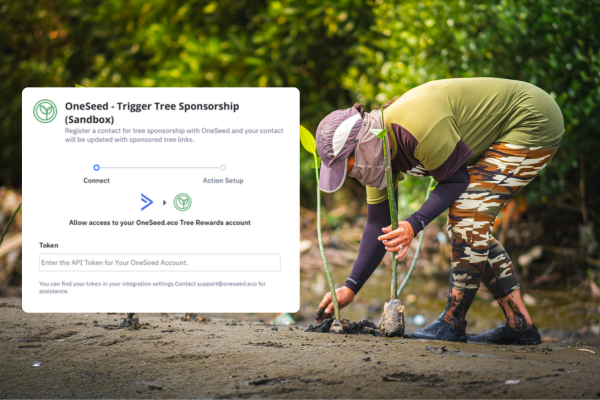
OneSeed connects its verified tree-planting platform directly to ActiveCampaign workflows. Using Zapier or the REST API, you can trigger a verified tree planting for any subscriber action you can automate: form completions, list joins, tag changes, goal completions, survey responses, webinar sign-ups.
The subscriber receives a personal tree profile: GPS coordinates, a photo of their tree in the ground, and the story of the community planting it. Trees are planted through OneSeed's verified global network across the Philippines, Kenya, Bolivia, Honduras, Nepal, Tanzania, Thailand, and Mexico, in partnership with the UN Decade on Ecosystem Restoration.
For your team, every planting is tracked and reportable, which is useful for sustainability reporting, ESG communications, or simply showing customers what their engagement adds up to over time.
Three ways ActiveCampaign users are using this
Lead generation. Attach a tree planting to whitepaper downloads or contact form submissions. The reward feels proportionate to the ask in a way that a discount code does not. You are not cutting into your margins, and the subscriber is not gaming a promotion.
Newsletter growth. Turn your sign-up form into a small environmental action. "Subscribe and we'll plant a tree" stands out in an inbox culture where batch-and-blast emails actively damage brand loyalty for 23% of consumers. A values-aligned hook attracts people who want to be in a relationship with your brand, not just redeem something and leave.
Re-engagement. Offer to plant a tree when an inactive subscriber re-engages with your content. It reframes the relationship. Instead of "we noticed you have been quiet," it becomes "come back and help us do something good." ActiveCampaign's own 2025 platform data shows 93.7 million net new subscribers were added across the platform last year, with a 40.4% average open rate. The infrastructure for high-volume, behavior-triggered automation is there. The question is what you are automating toward.
Getting started
Setup takes a few minutes via Zapier. No code required. You choose which subscriber actions trigger plantings, select your forest project, and configure how recipients are notified, all in OneSeed's dashboard.
You can find OneSeed in the ActiveCampaign App Marketplace, or go directly to oneseed.eco/activecampaign-integration to connect your account and book a demo.
OneSeed is a UN Decade on Ecosystem Restoration partner. Every tree is verified, photographed, and GPS-tracked.