
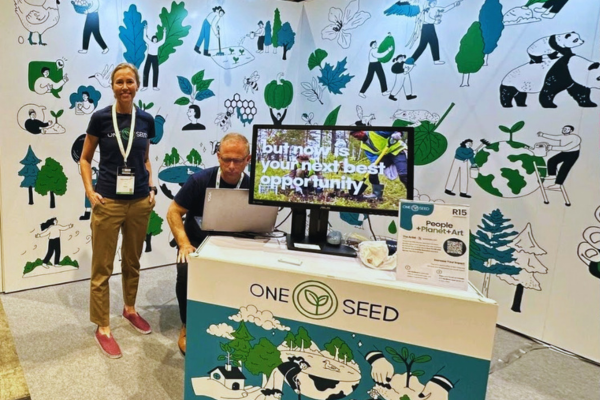
What happens when your conference demo and your product are the same thing?
In October 2022, OneSeed co-founder and CEO Ray Horan walked into Hong Kong's Convention and Exhibition Centre for ReThink HK — the city's largest sustainability business conference — without a traditional sales pitch. No slide deck. No printed brochures. What he had instead was a QR code and a genuinely different idea about how to introduce a new product to the world.
The result: 49 instant demos, 28 sales meetings booked, and a live client signed within seven days.
The Problem With Conference Networking
Trade shows and sustainability expos are notoriously noisy places to be an unknown startup. Everyone has a story. Everyone wants five minutes. And in a room full of ESG practitioners and business leaders — exactly the audience you want — standing out through conversation alone is an uphill climb.
The standard approach is to collect business cards, hope people remember you, and do the real selling in the follow-up email that most recipients delete.
OneSeed had a different problem to solve: how do you demo a digital tree-planting engagement platform to strangers at a conference in a way that is fast, memorable, and self-explanatory?
Ray's answer was to not demo it at all. He let people experience it.
The Setup: A Live Campaign in the Room
OneSeed connects businesses to verified reforestation projects, enabling them to plant trees as rewards for customer engagement, form completions, event attendance, employee milestones, and other touchpoints. The mechanics are simple: a person scans a QR code, lands on a brief lead capture form, and in exchange receives a tree planted in their name.
What they get back isn't a certificate or a vague promise. It's a personal tree bio page — a living record of their specific tree, pinned to a satellite map at its exact GPS coordinates. The page shows the species planted, its current age in days, how much CO₂ it has sequestered so far versus its lifetime target, which endangered species its habitat supports, and the restoration project behind it. It updates over time as the tree grows.
At ReThink HK, Ray ran that exact flow on the conference floor. Attendees scanned a QR code with their own phones, shared basic contact details to claim their tree, and within minutes had a link to a page showing their tree growing in a real forest — satellite view, species profile, carbon tracking, and all.
The demo was the product. The lead capture was built in. The follow-up email practically wrote itself.
"The excitement was palpable," Ray said afterward. "I watched their eyes light up describing ways to apply our product we hadn't yet considered. No explanation or education needed, they were selling OneSeed to themselves."
What's on a Tree Bio Page
It's worth pausing here, because "a link to your tree" undersells what the experience actually is.
Each OneSeed tree bio page includes:
- Species identity — common name, Latin name, and a photo gallery of the species, with context on its ecological role and why it was chosen for that landscape
- GPS pin on a live satellite map — the tree's exact location, visible from above in real forest canopy
- Carbon tracking — current CO₂ sequestered versus the tree's lifetime target, translated into relatable equivalents (kilometres not driven, for example)
- Biodiversity impact — which threatened or endangered species the restoration project supports, with species profiles and conservation status
- Restoration project detail — the specific project, its location, environmental history, and live weather conditions on the ground
- UN SDG alignment — which Sustainable Development Goals the project contributes to (Climate Action, Life on Land, Gender Equality, Decent Work)
The page lives permanently at a unique URL. It's shareable, bookmarkable, and updates as the tree ages. For a sustainability professional standing at a conference, receiving that link in real time — for a tree they just claimed — is a fundamentally different experience than any sales collateral.
Why It Worked: The Conference Context
ReThink HK's third edition, held October 5–6, 2022 at the HKCEC in Wan Chai, drew more than 3,000 attendees — business leaders, sustainability practitioners, and those responsible for sourcing ESG solutions for their organizations. [Source: ReThink HK 2022] The conference featured over 300 speakers across seven themed theatres covering decarbonization, circular economy, people and purpose, and more.
In short: a room full of exactly the kind of people who would immediately understand why a brand might want to plant a tree for a customer, and who were already primed to think about environmental impact as a business tool.
The product-as-demo approach worked especially well here because:
The audience already had context. Sustainability professionals didn't need the concept of tree-planting explained. They needed to see how it worked in practice.
The value was immediate and tangible. Receiving a verified, trackable tree — species identified, carbon measured, endangered habitat supported — in under two minutes is a different category of experience than watching a product walkthrough.
The conversation starter was already baked in. After someone has just received their own tree bio page, the natural question is: "How does this work? Could we do this for our customers?"
The Numbers
From the two-day conference, OneSeed captured:
49 instant demos — roughly 2% of the total attendee pool engaged directly with the live campaign. That figure may sound modest, but those weren't passive badge scans. Each person actively opened a landing page, completed a form, and received a verified planted tree with a live tracking page.
57% conversion to sales meetings — 28 of those 49 leads converted into scheduled sales meetings. For context, industry benchmarks for B2B conference lead conversion typically run 5–15% (Intelemark), and cold outbound lead-to-meeting rates average closer to 2–5%. A 57% conversion from a warm, in-person interaction is well above either benchmark — and reflects the quality of intent when someone has already experienced your product before the meeting is even booked.
1 live client within 7 days — the first paying OneSeed client was signed within a week of the conference ending.
What This Approach Reveals About Product-Led Growth
There's a growing body of evidence that product-led growth — where the product itself drives acquisition and conversion — outperforms traditional top-down sales models in many B2B contexts. OneSeed's ReThink HK approach was a live experiment in PLG applied to in-person events.
A few things worth noting about why the mechanics translated so well:
Zero explanation overhead. Attendees didn't need a pitch to understand OneSeed. The experience was self-explanatory. This matters at conferences, where attention spans are compressed and everyone is talking to ten other vendors.
Instant emotional connection. Seeing your named tree pinned to a satellite map of a real Philippine forest, with its carbon contribution tracked in real time, is not a passive experience. That response doesn't need a follow-up to trigger — it happens on the spot.
Pre-qualified leads by design. Anyone willing to stop, scan, fill out a form, and engage with the experience has already demonstrated a baseline level of interest. The lead capture wasn't extractive; it was earned.
The Bigger Picture: Eating Your Own Cooking
There's an old software development phrase — "dogfooding," or eating your own dog food — that refers to companies using their own products before asking customers to. It builds credibility, surfaces real issues, and demonstrates genuine belief in what you're selling.
OneSeed's ReThink HK activation was an unusually clean version of this. The company wasn't just using its own technology to manage internal operations. It was using its product as the literal mechanism for launching the company.
Every tree planted at that conference was proof of concept. Every lead captured was a live demonstration. The first client that signed had watched the whole thing happen in real time.
Replicating the Model
The ReThink HK activation isn't a one-off story — it's a repeatable playbook. The same mechanics work for:
- Trade shows and expo booths — generate qualified leads and create memorable interactions at any event. Learn more about impactful events.
- Customer loyalty programs — plant a tree for every purchase, review, or referral. See how impactful loyalty rewards work.
- Employee engagement — reward milestones, onboarding, or recognition moments with a tree. Explore impactful workforce use cases.
- E-commerce checkouts — give customers a tree at the point of purchase. See impactful commerce.
- Surveys and lead capture — the exact mechanic from ReThink HK, built for eco surveys at any scale.
The core principle holds across all of them: when the product itself is the demo, the sales cycle starts the moment someone engages.
Try It for Yourself
The best way to understand what ReThink HK attendees experienced is to see it directly. This is a live OneSeed tree bio page — a Grey Birch (Bridelia insulana) planted in Besigan, Philippines, with its GPS coordinates, carbon tracking, and three endangered species its habitat supports, including the critically endangered Philippine Eagle.
That's what someone receives when they are rewarded with a sponsored OneSeed tree.
OneSeed offers $20 in free tree credits to get started — enough to try out your own version of the activation at a conference, in a survey, or as a one-off customer or employee moment.
If you want to talk through how it fits your specific context, book a call with our team.
About OneSeed
OneSeed is a reforestation impact platform that enables businesses to embed verified tree-planting into e-commerce, loyalty programs, employee engagement, surveys, events, and API workflows. Planting partners include Eden Projects Association (Philippines), Guardians of Nature & People (Kenya), Ketrawe (Bolivia), APREH (Honduras), and Ponterra-Esperanza (Mexico). OneSeed is a UN Decade on Ecosystem Restoration partner.
Originally published on The Groundwork, OneSeed's blog on reforestation, impact, and the business case for trees.